Tuesday, March 8, 2011

Capital One: A Rant


Credit cards are an important part of cruising, we use them for everything we can.  It’s easier and more convenient than keeping cash around.  I am fortunate to have inherited USAA benefits and have never had a problem with banking from abroad with them.  I have on a few occasions had them cancel my credit card and reissue a new one when a credit card server has been compromised.  This can be a hassle but is also a good safety from having my card number stolen and used.  They will FedEx a new card to any location in the world, as I’ve known cruisers who have encountered this with them while in the Bahamas.  That can alter plans as even FedEx can take a while to arrive in some destinations.  I solved the problem simply by having a spare card I can activate if needed.  The only drawback is that there is a 1% foreign transaction charge.  This is really not a large amount of money, but eventually over the year it does add up, especially if any large purchases are made.  When I heard that Capital One has no foreign transaction fees it sounded like a good reason to get a Capital One card.  I had no idea what I was signing up for.
            I signed up for a card in my name and added my husband to the account.  This however means they will not talk to him about the account at all, even though he’s authorized to make purchases.  Since I’m usually the one dealing with the banking this is not really a problem.  When I called in to activate the card, I had the most annoyingly thorough verification process I have ever experienced.  I lost 40 minutes of my life that day. 
We happily used the card a few times and then poof it was declined.  Half an hour later after a phone tree and being on hold, I could talk to someone who turned my card back on.  It was used in a foreign country so that automatically triggers a possible fraud alert.  I informed them that I would be traveling in foreign countries for the foreseeable future and please note that on the account.  I should have realized I’d be in for trouble when they wanted to know how many days that would be. 
            I never considered my credit limit on my card since I always pay it off right away, but when were struck by lightning in Grenada and looking at paying out nearly $20000 until we got the insurance settlement suddenly the credit limit was important.  I called to ask for a raise and they simply said it was declined.  No reason would be given.  Google helped me find out that they simply have a policy of never increasing a credit limit when asked; it would have been nice if they could have told me that.  So we just signed up for a second card, I put it in IB’s name and poof we got a higher credit limit.  This is when the real fun began. 
They allowed us to use the new card to charge over $4000, and then chose to put a hold on the account for possible fraud.  So now we can’t use the card, we can’t access the account online to pay the bill and if we don’t sort it out it will go to collections and reflect on our credit score.  Eventually they did send a paper bill and I had my ‘secretary’ back in the states mail a check to pay it.  When we called to sort it out, they won’t speak to me, because it’s IB’s card.  They run him through the various security questions and then tell him they don’t believe he’s IB and he needs to identify his identity.  What?  I don’t know if they already had something flagged on his account or if he answered a question wrong, which can happen a lot with us.  Since we have a skype phone number, a local (whatever country) cell phone, and sometimes I’ve used my mom’s number.  Usually we always use our PO Box address from WV, expect some things still have our land home address, but Capital One insists on a physical address, as if we all are supposed to fit into this “American” mold.  So I used my mom’s address.  It’s really easy to be confused over security questions with our lifestyle; sometimes it can take me three tries.  Either way they now want a utility bill, his social security card and his drivers license or passport faxed to them before they will even speak to him!  Of course no one understands why we can’t produce a utility bill, that’s unfathomable.  And no bank account with a physical address?? Unheard of!  And really does everyone carry a social security card around these days?  Well he actually did that for many years, which is why you can’t actually read it anymore.  Eventually we did change the address with our bank, wait for a new bank statement and faxed that to them with the illegible social security card over an internet fax site with the credit card number .. and this is more secure than asking a few questions on the phone???  Well they apparently got the documents because they called, but of course wouldn’t speak to me, even though they called, and know my name since it’s listed on his account.  They would not even tell me if they have all the required information to turn the account on or not at this point.  We are seven months into this and still don’t have a useable card.  During this time my card has been turned off three times for suspected fraud, luckily they seem to always believe I am who I say I am when I call in, but it still means always carrying a second card because I never know when it will work.  I’ve never experienced such ridiculous frustration; perhaps I’ve just been spoiled by USAA.  I’m starting to think 1% is not so bad, at least I know my card will work, and my bank will work with me not against me.

Thursday, February 24, 2011

On Dry Land


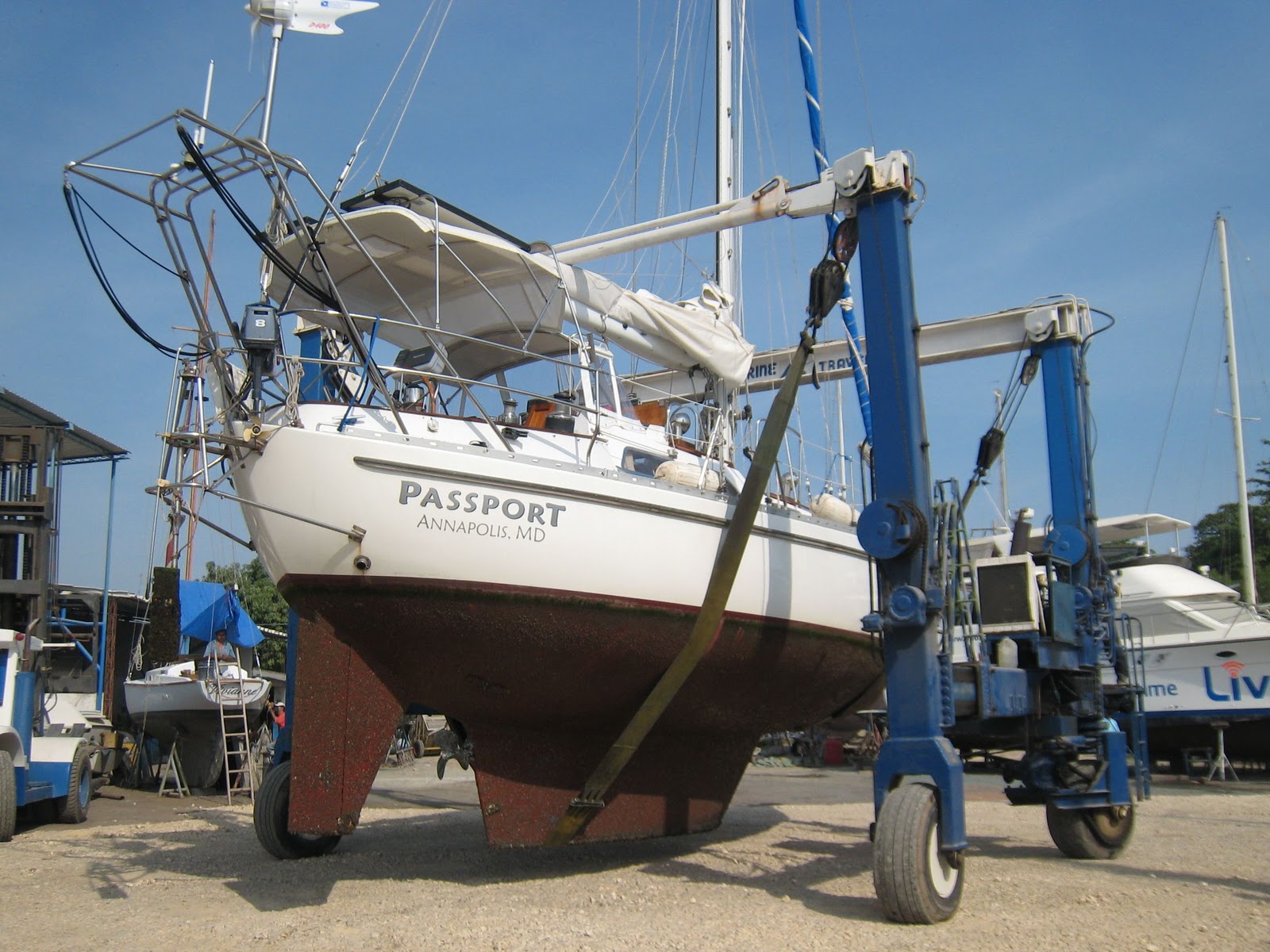
It comes around every few years, like it or not.  We procrastinate, push back deadlines, and scrape the bottom to get by for just a few more months, but inevitably in the life of every cruiser comes the day that the boat must be hauled out of the water.  A year ago we were forced to switch to a new insurance company while in Georgetown, Exumas, when we discovered our current company did not insure the Caribbean.  We were fortunate to find a company that would insure us for one year before requiring a new survey, a very good thing since Georgetown was not known as somewhere you wanted your boat hauled out unless absolutely necessary.  A year sounded like plenty of time … that was a year ago.  Last fall, while in Grenada, we were supposed to complete our haul out for our survey, install a new transducer and inspect for lightning damage after our strike.  We managed to put it off till Colombia.  We almost tried to extend it for another few months and go to Panama first, but finally bit the bullet and hauled out two weeks shy of our one-year deadline.
            Cartagena, Colombia has three options for haul out yards:  Manzanillo Marina Club, Todomar CHL Marina, and Ferroalquimar.  We had several very high recommendations on hauling out at Manzanillo and they have a couple of rooms to rent, so we decided to go with them since we really don’t want to live on the boat for a month on land.  A boat on land means, no refrigerator, no toilet, and climbing a ladder to get on and off.  Generally not a fun experience, and add some messy dirty work to the mix and you get the picture.  Our initial plan to paint the bottom, maintenance that needs done every couple of years to prevent the bottom of the boat from becoming a reef, and survey has grown and taken on a life of it’s own.  Somewhere way down on our project list was to repaint the decks.  The nonskid was worn off in places, most of the rest is very oxidized, and a few fiberglass repairs need done.  Even though this is expected to be a very expensive job, we had a quote of over $20,000 in the US on our last (smaller) boat, we figured why not just get a quote and see.  Well, when the quote came back for about $4000, to have the decks gel-coated it was hard to say no.  Gel-coat is usually harder to apply and often found just on new boats, but it’s something they do here and do relatively well.  So we are taking stuff off the decks, taping things up and getting it done.  The bottom paint is getting done, but going one step farther and stripping all the old paint off, adding some barrier coat and new toxic paint to keep the marine life in the sea and off our boat.  Inside the boat, we have a great opportunity to refresh the interior wood with a nice coat of varnish while we don’t have to sleep in the boat; as well as some other small projects.
            We are getting settled into our apt, it’s no 5-star resort, but it does have A/C, a small kitchenette, and enough space I can get some sewing projects done out of the heat.
Moving the travel lift over the boat to place the straps underneath.

Pulling the straps up tight and making sure the boat is centered.

Lifting the boat out of the water.

Moving her onto land.

Moving her to her new parking space.

Parked on land.

Pirates!


I am not the type of person that is glued to the news, generally I don’t hear any news until it’s either posted on facebook by one of my friends or my Mom calls to tell me.  Just a few weeks ago the disappearance of Don North aboard s/v Windancer in Panama was brought to my attention by email.  The story was close enough to my lifestyle and current geographic location to catch my attention.  I started scouring the web, following the unfolding story that within days quickly led to the capture of Javier Martin; serial murderer and pirate. 
            Just this past week I heard of the hijacking of s/v Quest by Somali pirates.  Although not a location near to where I am, with confusing vague reports initially hitting the media, I once again turned to the internet to scour news reports and cruising forums.  My initial response to hearing of their capture is very much like that of many people; why the heck were they there, don’t they know better. 
            For a sailor or cruiser, piracy is a part of lifestyle.  How big the risk is to any given vessel depends on choices made and sometimes just dumb luck.  When we first announced to friends that we were heading south to cruise the Caribbean the most common question we heard was;  “What about pirates?”.  My husband’s joking reply was always, “Arg, we are okay for now, but if finances get tight we might consider it.”  Although there can be pirate attacks in the Caribbean and Bahamas, it’s not common, usually the biggest problem is petty theft, which is frustrating, annoying and can be expensive it’s not life threatening.  Our first real concern of piracy is when we decided to leave Grenada and head west.  Venezuela has had an increasing number of pirate attacks over the last few years, and they have become increasingly violent.  We had a choice to make; to go to Venezuela or not.  Sitting at home only looking at news reports it could make the decision look really simple; pirate attacks = don’t go.  However, sitting in Grenada only a few hundred miles away from Venezuela the decision was not so black and white.  We talked to cruisers that had been going there for years, and even given the increase in attacks they were still going back this year.  They all had advice, several areas to keep clear of, travel with a buddy boat or two, avoid traveling near shore at night.  There were some contradictions to their advice, as we were told there was one part of the mainland to stay away from and the rest was okay so long as you were careful, travel during the day and with other boats.  One area we were told was “okay” to go, we were told was also the site of an attack and murder of a cruiser earlier in the year.  It does make you go..  hmph…  Our decision went from definitely don’t go… to sounds like it may be okay .. to only go to the out islands.. to don’t go.  Meanwhile we had friends that did decide to go, avoiding the mainland but visiting the islands.  While they were in Isla Margarita, we heard about a cruiser whose boat was boarded at anchor and he was killed.  When asking our friends about the event their response was that he was in the wrong anchorage and they were relatively unconcerned, and enjoyed the rest of their time in the Venezuelan Islands with no problems at all.  We still chose to not go, for us the possibility of dealing with a violent attack was more of a risk than we wanted to take, even though we had quite a few friends who did go. 
            I imagine for s/v Quest, they had a similar story behind their decision to go.  It just so happens their decision was the wrong one.  I still do not understand their decision to go through pirate-infested waters and I don’t agree with it.  But I do try to understand that it is not necessarily a black and white decision, as it would appear to those sitting in their comfortable homes, not seeking adventure or travel and looking only at the limited news media they are presented with.  Although pirate attacks in the area are prevalent, I’m sure they knew that rarely is a private yacht hijacked.  The pirates are interested in large commercial  ships that they can get high ransoms for from corporations.  Which brings the question to mind, are we aiding the problem of piracy off Somalia when we choose to pay upwards of $2 million for a ransom?  I don’t pretend to have a solution or even an idea of what to do about the situation, but it seems that for every large ransom paid we are just supporting and encouraging their “business”.  Back to the subject;  I expect s/v Quest also knew private vessels that were successfully transiting the area and making it to the Mediterranean.   I’m sure they read blog accounts, talked to people who have done it, possibly even close friends.  They probably knew that very few pirate attacks off Somalia end in death, they want money for ransoms, and a dead body won’t get that.  Perhaps they thought that the risk of capture and eventual release was small enough to risk the trip.  The convoy of 30 boats they had been traveling with split up and abandoned their plans to sail to Oman when they were unable to obtain a naval escort.  The boats then made their own plans to continue on or change direction.  I doubt the s/v Quest knew that 2 days before they were hijacked the US sentenced, Abduwali Abdukhadir Muse, the pirate apprehended for hijacking the Maersk Alabama in 2009, to 33 years in prison.  This act changed the tactical plans of the Somali pirates, no longer were they just getting ransoms but now they want to make a statement of retaliation against the US.  At this point in the events s/v Quest, despite their planning and good or bad decisions, encountered bad luck.
            The situation with Somali pirates has gotten out of control.  They are not attacking just along the coast of Somalia, but operating from “mother ships” that allow them to be hundreds of miles out to sea.  There are reported attacks clear throughout the Arabian Sea; from Africa to India and even as far south as Madagascar.  How long until their range goes even farther?  Where will it end? 
            Back in Panama, authorities are still investigating the murder of Jean Pierre Bouhard and Don North, collecting evidence to obtain a certain conviction on as many counts as possible of Javier Martin.  A very different pirate tale from those in Somalia, but the outcome is not so different.  Javier Martin did not board their boats by force, but actually had some form of professional relationship with both of these men, gaining their trust to get on their boats then murder them at sea in an attempt to take their boats as his own.  These events were set into motion after Martin sunk his own boat in the San Blas islands.  It’s very possible that he also gained possession of that boat by murder back in 1997; that is still under investigation.  Don Winner at the panama-guide.com has been instrumental in the capture of Martin and has current articles on the investigation.  Before he sunk his boat and started the search for a new one, Martin carried backpackers aboard his vessel from Panama to Colombia.  I can only wonder what some of those backpackers, who may have learned of his arrest, now think of their experience at sea with a pirate.

Friday, January 7, 2011

Santa Marta


Santa Marta was not originally on our planned itinerary.  Whatever exactly a planned itinerary is when cruising, I think it’s more of a vague concept of an idea of something that could be done should we so choose to do it.  We quickly found ourselves very comfortable and sad to leave.  With guests arriving in Cartagena we had a week to enjoy Santa Marta and then move on.  If we make it back again we will plan to stay longer, maybe next year we will return.  We’ll just add that to the “planned itinerary”.
We did have just enough time to sample the food and mojitos.  It seems that most of the good restaurants with a nice atmosphere to hang out in are generally well hidden until you stumble upon the right streets.  Our first day out, we wandered the streets for several hours and just managed to miss the ones with the inviting restaurants.  We did find several plazas, the gold museum, the chapel and the main shopping district.  Our second day out we were given some directions and discovered Agave Azul.  It’s a great little Mexican restaurant, with 2 for 1 happy our drinks.  It’s not a US tex mex restaurant, but they had amazing dishes full of flavor all for the price of…. Well had I written this when I should have over a month ago I could probably tell you an accurate price, as it is I’m going to take a really good guess and say the meal was about $10 US.  Just a few days before we left we managed to find a walking only street that was just bursting with small cafĂ©’s.  We wandered into Lulo for some more happy hour (2 for 1) mojitos.  They may have been some of the best in Santa Marta but it will probably require more research to be sure.
Marina Santa Marta felt both comfortable and safe.  The marina just opened this year and many of its facilities are still under construction, but the slips were completed with power and water.  There were no restrooms or any other facility yet completed but they did pick up trash right at your boat on the dock.  Every day we would see a security guard patrolling the docks.  The floating docks and finger piers made getting on and off the boat very easy, which is not always the case with the marina’s down here.  We were given a discounted rate for the week and paid $162.00 for our stay.  The negative aspect of the marina and the stay in Santa Marta all has to do with the wind.  The wind will whip down off the mountains and we often saw 30 – 40 kts of winds for days at a time.  The boat felt safely tied up so this was not too uncomfortable, but the beach is located upwind from the marina and a super fine dusting of sand would coat every surface of the boat inside and out daily.  The sand was highly annoying to say the least, but it wouldn’t stop me from going back, it may however convince me to close up the boat and run the air conditioner next time.

Sunday, January 2, 2011

Aruba to Colombia


The seas behind our boat.
Christmas winds.  Growing up in landlocked West Virginia I never heard the term.    Sailing down to the southern Caribbean, if I heard it I paid it no attention.  Researching information on the Internet about the passage from Aruba to Colombia the term started popping up more frequently.  When we finally left Aruba, I understood:  Christmas winds.  For those of you still living a non-seafaring landlocked life who may be unfamiliar:  Christmas winds get their name because of the time of year they arrive ... Christmas time.  During the late summer and fall the trade winds weaken with periods of light winds.  Around Christmas time the trade winds blowing all the way from Africa pick up and intensify, bringing strong winds across the Caribbean at a sustained 25-30kts or more, lasting for weeks at a time.
They say experience is the best teacher, and it certainly makes concepts sink in deep.  We had heard about these Christmas winds, even talked about them as we planned our passage from Aruba to Cartagena, Colombia.  Somehow though the reality of them didn’t quite sink into our little brains very solidly.  We had experienced week after week of mild weather and somehow thought there was still more yet to come, tossing the whispers of Christmas winds to the back of our consciousness.  The passage from Aruba to Cartagena is known as one of the five worst passages in the world.  In heavy winds the seas can build quickly and become dangerous.   Many boats have left Aruba with what sounded like a good weather window and found themselves in 40-50kt winds, 30ft seas, even seeing breaking waves and confused seas with waves coming from different directions.  As we watched our weather windows, to make the 400-mile passage, disappear we started to realize the true meaning of Christmas winds.  We also realized that we had broken our own rule, and made plans to meet visitors in Cartagena on a specific date.  Although they did have fair warning that buying their tickets in advance there was a possibility we wouldn’t make it there.  However even though they were warned I really want to see them and I don’t want to spend another month waiting for a weather window!  So instead of the 10–15kt winds and 4 ft seas we had hoped to have for a 4-day passage, we were now looking at 20-25kt winds for the foreseeable future.  Time to change our plans. 
We chose to take advantage of a 2 day weather window of 20kt winds and 6 ft seas, that would get us to the coast of Colombia where we would duck into an anchorage for a day or two until we got more “settled” weather.  It seems that once the Christmas winds kick in 20kts is about as “settled” as we can hope for.  Since leaving Grenada we had been traveling with Dave and Wendy on Elysium, although we had planned to make the passage to Cartagena together at this point we both made different decisions.  Elysium wanted to wait for a 4-day window that would allow them to stay well offshore and travel straight to Cartagena, and we decided it would be best to take advantage of the 2 day weather windows and hop along the coast to assure we would arrive in Cartagena before the 13th of January.  Sadly we said good-bye to our traveling companions, but at least we look forward to seeing them again soon in Cartagena.
With the winds behind us, we had an easy passage with the boat gently rolling from side to side.  Unfortunately my stomach does not appreciate the gentle lolling and retaliates until I medicate.  We made to into the anchorage at Bahia Honda the next morning and were recommended by our weather guru, to stay put and not continue on, as the winds were to build during the day and overnight.  So stay put we did; but not happily.  We had trouble finding a good spot to anchor.  The bay is very wide, about 6 miles, and the mouth is also very wide, allowing the ocean swell to roll in and nearly fill the bay.  We had read a post from other cruisers who were recently in this bay and loved it, of course I didn’t know exactly where they anchored and I don’t think they saw the sea conditions we did.  It is a pretty area, very remote with nothing around but arid desert plateaus.  We finally settled on a spot in the northeast corner that was out of the swell.  The water got shallow while still a couple of mile from the land, getting as close as we could to shore we anchored in 9’ of water choosing to deal with the wind chop that was blowing in.  It was not perfect but it was comfortable enough for a night of sleep.  So we thought.  We thought wrong.  During the night as the seas built so did the swell in our anchorage, wrapping around the edge of the bay 4ft waves rolled in directly toward our boat.  At first light we were up, we needed to leave.  We waited long enough to get a weather forecast, pulled up anchor and headed to sea.  The forecast didn’t thrill us, but it was better than where we were and Chris Parker gave us the go ahead to head to Santa Marta.  We had 20-25kts of wind with 12ft seas behind us.  With 10-second intervals the seas were comfortable, much better than the anchorage we just left, and we settled in for the 160-mile journey. 
Throughout the day the wind and seas subsided, and eventually so did my stomach.  By the end of the day I was no longer medicated and even cooking, well sorta .. I put stuff in the oven and turned it on till it was hot; at sea I think it counts.  We were even visited by a pod of dolphins, the first we had seen in a very long time.  One had a young calf with her, and one had no dorsal fin, he must have an interesting story.
The following morning we checked with Chris for the possibility of continuing on to Cartagena, but he recommended staying in Santa Marta over the weekend as conditions were going to be building throughout the day.  Within 2 hours the seas were building up to 9ft and winds gusted up to 30kts and above.  We were happy to stop.  As we pulled into the bay the water was calm and the mountains blocked the winds.  We contacted Marina Santa Marta on VHF 72 and got tied up to a slip: our home for the next week.

Saturday, November 13, 2010

Leaving Grenada

Leaving Grenada

I remember a day sailing through the Bahamas still bundled in a blanket at night , even with the warm days the nights on the water with a constant wind were chilly.  I would read books about other cruisers in the tropics sailing naked through long stretches of open ocean and I would wonder …  under my blanket and winter hat .. how hot does it have to be … I no longer wonder .. I have arrived!  I do however find a loose shirt necessary sun protection (preferably with a useful pocket to hold my ipod), no matter how warm it is.
            As we prepared to leave Grenada for our four-day voyage to Bonaire, we went through the boat storing away anything that may slide about or fall.  I made sure I had my “sea bag” packed and ready to go.  Since I am sometimes prone to seasickness I pack a small canvas tote bag with things I may need/want during the voyage, so I can avoid multiple trips below decks for something I may want.  My ipod, kindle, journal, water bottle, eye mask, snacks and motion sickness drugs all go in, along with anything else I may find necessary.  My bag goes everywhere with me so my stuff is always close at hand.  I set one out for IB as well, but I find other than when he grabs it for snacks it tends to sit on one location and his things are always in multiple locations. The last thing we did was to deflate the dingy and lash it down on deck.  For short jaunts we leave it hanging on the davits, but for a multi day passage it is safer to have it on deck and besides that leaves our wind vane (that we have never used) accessible for use.
            Time happens differently at sea.  The hours and days blur together.  Time passes:  sleeping when you can, eating, thinking about what you want to eat and working up the energy to actually cook it, reading, listening to audio books, sleeping.  Even basic meal preparations at sea can be an exhausting challenge.  With the boat constantly rocking back and forth, nothing can be left on the counter without being secured.  A knife can NEVER be set down, except in the sink.  And the whole time you are juggling all the pieces of your meal, you also have to balance yourself.  And hopefully when it’s all done you will still feel like eating J
Sleeping is definitely a highlight of the day.  Since someone always has to be on watch, we sleep in shits,  Every yacht breaks up shifts differently.  We used to setup a time schedule but have found working with our natural sleep tendencies work better for us.  If I can sleep at 6:00pm, I do or as close to that as I can.  IB stays on watch until he gets really tired, usually around midnight, then I’m up till nearly dawn.  We take turns napping as needed during the day.  The schedule worked so well on this trip we arrived in Bonaire feeling relatively refreshed, rather than the typical sleep deprived.  Of course we also spend time navigating, setting the sails and checking weather updates.
            On day 2 .. or was it day 1 .. I think it was day 2 .. . either way IB opened the engine room to find smoke rolling out .. the alternator had overheated and fried.  Our new alternator, from after the lightning strike, arrived DOA, we could not get the damaged one from the lightning strike repaired in Grenada, so the original one we had rebuilt in the states was installed and working before we left Grenada.  It lasted about a week.  No alternator, means no charging the batteries from the engine.  The solar panels and wind generator do a good job of keeping power up pretty well but we still loose a lot at night.  Running the chart plotter, radar, autopilot, refrigerator and freezer all add up.  The first thing we did was turn off the freezer.  Then we finally got out the lines and hooked up the monitor wind vane.  It seemed an appropriate time to finally start using it.  Once we got it set up right, (and I read the directions on how to use it) we had it steering the boat beautifully .. and power free!  IB did managed to hobble together an alternator and get it working so we didn’t have to be too worried about our power use, I’d hate to have turned off the radar and chart plotter!  It will still need to be replaced/repaired, but for the moment it is working.
            The rest of our trip was relatively uneventful, other than dodging some squalls on our last night as we neared Bonaire.  We pulled into the harbor at 9:00am on the 13th of November and picked up a mooring.  It’s great to be somewhere with clear water again, where we can see the sand under the boat.
 

Our Sails

Sunset at Sea

The view at sea

The Monitor Wind Vane that is steering the boat

Tuesday, November 9, 2010

Grenada

Downtown St. Georges
Grenada.  Adult summer camp for cruisers.  That about sums things up nicely.  From Mt Hartman Bay there is a “bus” (all the buses on the island are just vans) that leaves from Secret Harbor Marina every Wednesday and Friday at 9:30am to take cruisers to the grocery, hardware, chandlery or nearly anywhere else they need to go for just $10 EC.  ($1 US = $2.7 EC)  The bus is a great benefit that allows easy transportation to get into town and buy supplies.  The bus is also a real PITA, during many trips a lot of time is spent waiting for someone at a store you don’t need to go to, and resulting in a long day with many stops.  So it’s good, it’s bad, we all love the marina bus and we all grumble and complain about it. Every morning except Sunday there is a local cruiser net on VHF channel 68.  They have a weather forecast; information on local businesses including any specials happening; treasures of the bilge that gives cruisers a chance, to sell, buy, swap, or give away items unwanted on their boats; and different cruiser events.  Tuesday is movie night at Clarks Court Marina; it’s also 2 for 1 pizza night at La Phare Bleu Marina.  There are watercolor classes, yoga classes, tutoring kids in reading at the Mount Airy Young Reader program on Saturday morning, and French and Spanish lessons. If you lack something to do here it is simply because you are not doing something.  The first couple of weeks we zipped around from one activity to another, meeting new friends and enjoying being “settled” for the first time in a long time.  It didn’t take long for the demanding social schedule to become too much so we slowed down in our participation level. 
            We went with a group up to the Seven Sisters falls.  IB and I had been up there on our own once, but taking the public bus and hiking in to the two main water falls.  We were rained on as we left and had a hard time getting a bus back to town although we finally did.  When we found out a group was going and hired a bus to take us and wait on us it sounded like a good day to get off the boat and enjoy some cool air and fresh water.  Although summer in Grenada is hot and humid every day, just up in the mountains the air is cooler, less muggy and the waterfalls very cool and refreshing.  The group we were with hired a guide, and once we reached the main two waterfalls he took those that wanted on up a rugged path to the top of the seven falls.  From there we followed the water down, jumping down each fall as we went, ending with the highest fall of about 35 ft. 
            After our first week on Grenada we decided to go into the marina to be able to run our air conditioner and have the dock and extra power to work on some of our summer boat projects.  I also made plans to go back to the States to visit my family while IB worked on some of the dirtier projects.  It turned out to be a good plan, he got a lot of work done while I was gone, and I didn’t have to live in the dirty chaos while he did it.


Rebecca jumping Seven Sisters Falls


IB jumping Seven Sisters Falls


The hike to Mt Qua Qua over looking Grand Etang Lake

The kids at the Mt Airy Young Readers program
Yoga on the docks

Our "home" at Secret Harbor Marina

The anchorage at Mt Hartman Bay